|
'Homebrew' NV RAM
Non-volatile RAM is great for retro computer projects as code remains in memory indefinitely between sessions,
with no need to re-load every time the power has been off. You could even include the boot ROM code in there,
even write-protect a portion of NVRAM to give the functions of RAM and ROM in one chip!
Whilst there are many varieties of commercial NVRAM chips in Bytewide format, they tend to be a tad expensive.
An equally effective alternative is to use a CMOS static RAM and a DS1210 NV controller chip.
The truth is that many commercial NVRAMS actually use this same chip!
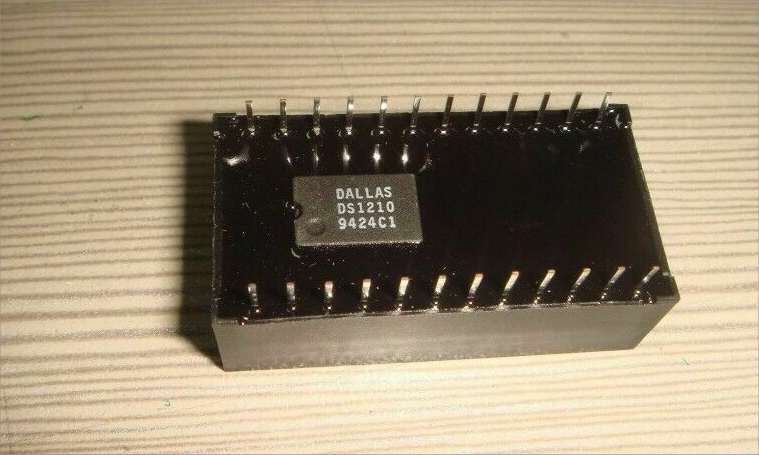
The DS1210 is a DIP8 and sits in series with the Vcc line and /CE on any CMOS static RAM, and with a tiny coin-cell turns
it into a non-volatile NVRAM. This typically works out about a third of the cost of a 'commercial' NVRAM such as a 48Z08 etc.
As soon as my DS1210s arrived I did a quick & dirty deadbug kluge of a DS1210 and an AS6C1008 128k x 8 CMOS RAM...
...sorry if this offends but it works great!
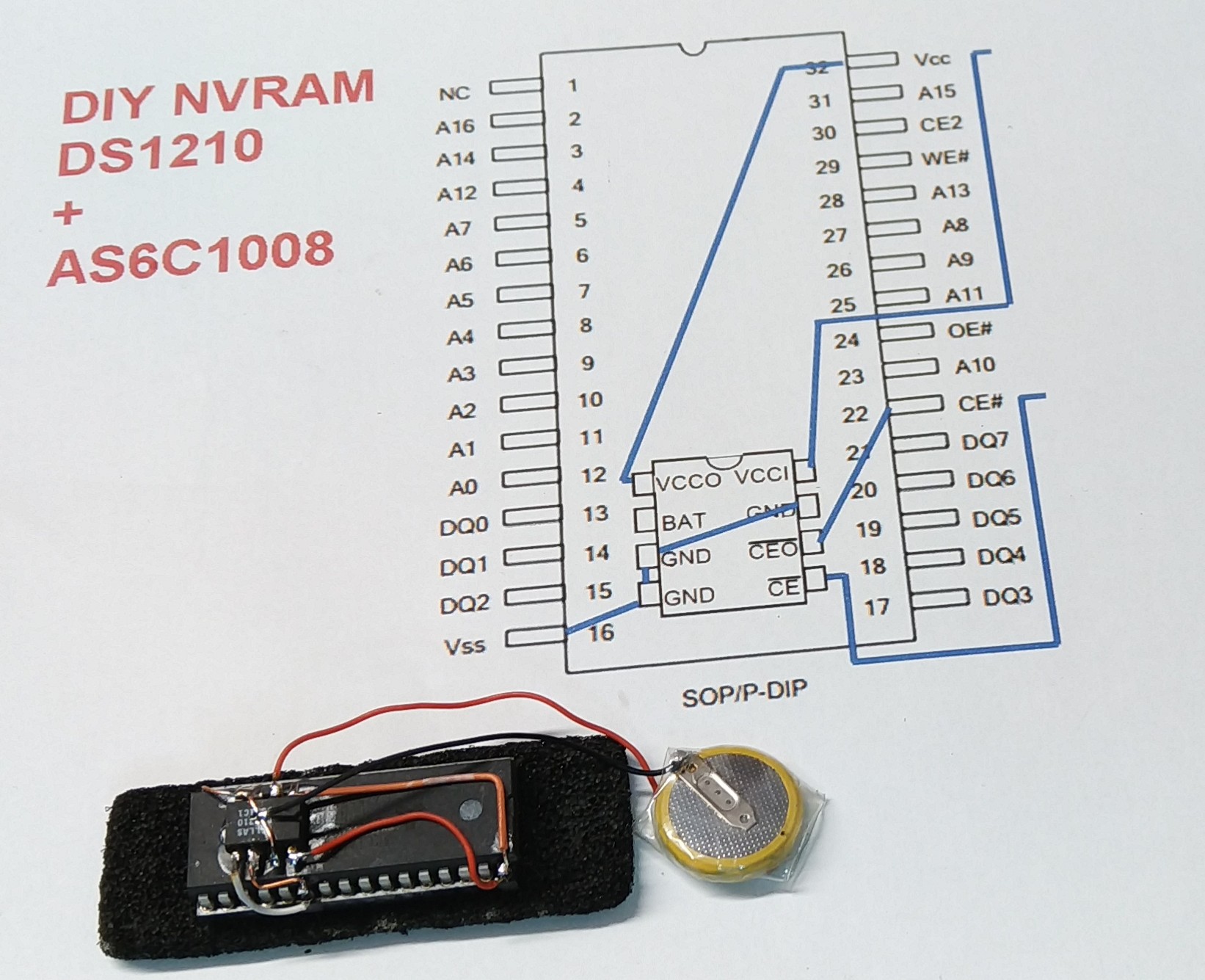
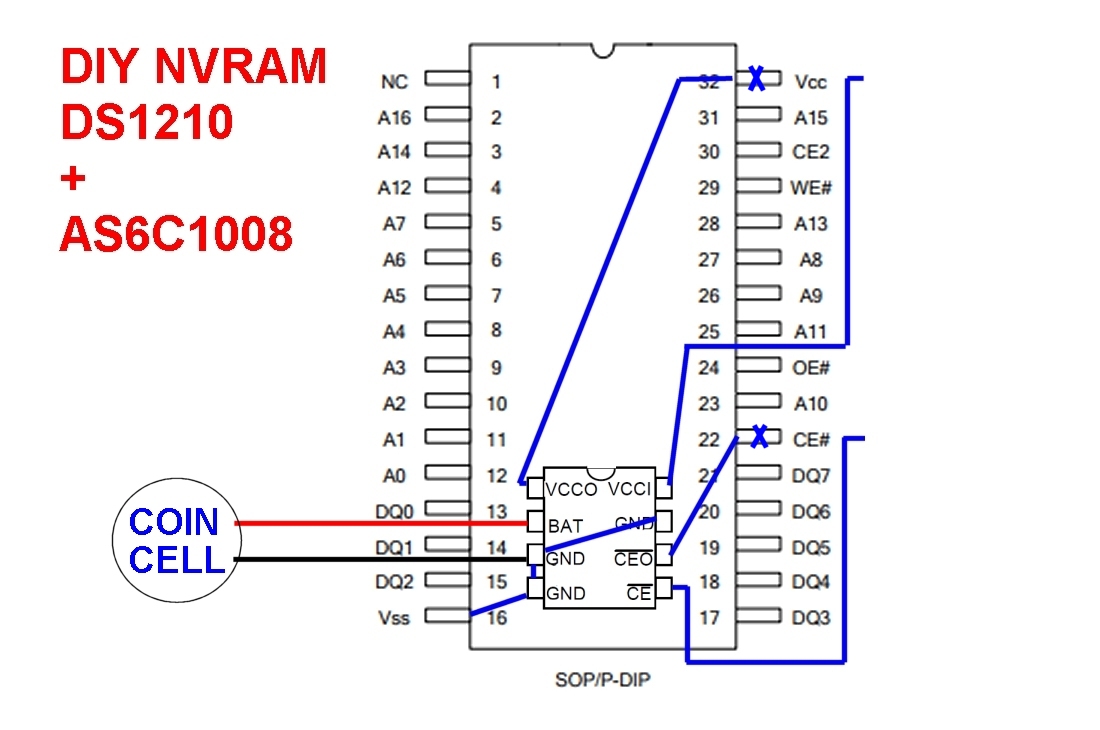
Its easiest to assemble the ram and DS1210 on a socket, which will plug into the PCB socket (ie socket in a socket)
Ram pins /CE and Vcc are lifted so as not to contact the 'carrier socket', and the DS1210 connections replace the lifted pins.
Here, the DS1210 is splayed, trimmed and glued to the RAM chip and is connected up with solid (single strand) wire.
Once it tested it could be hidden under a blob of hot-glue or POR - or even a cover, 3D printed in black PLA.
This diagram should make it clear:
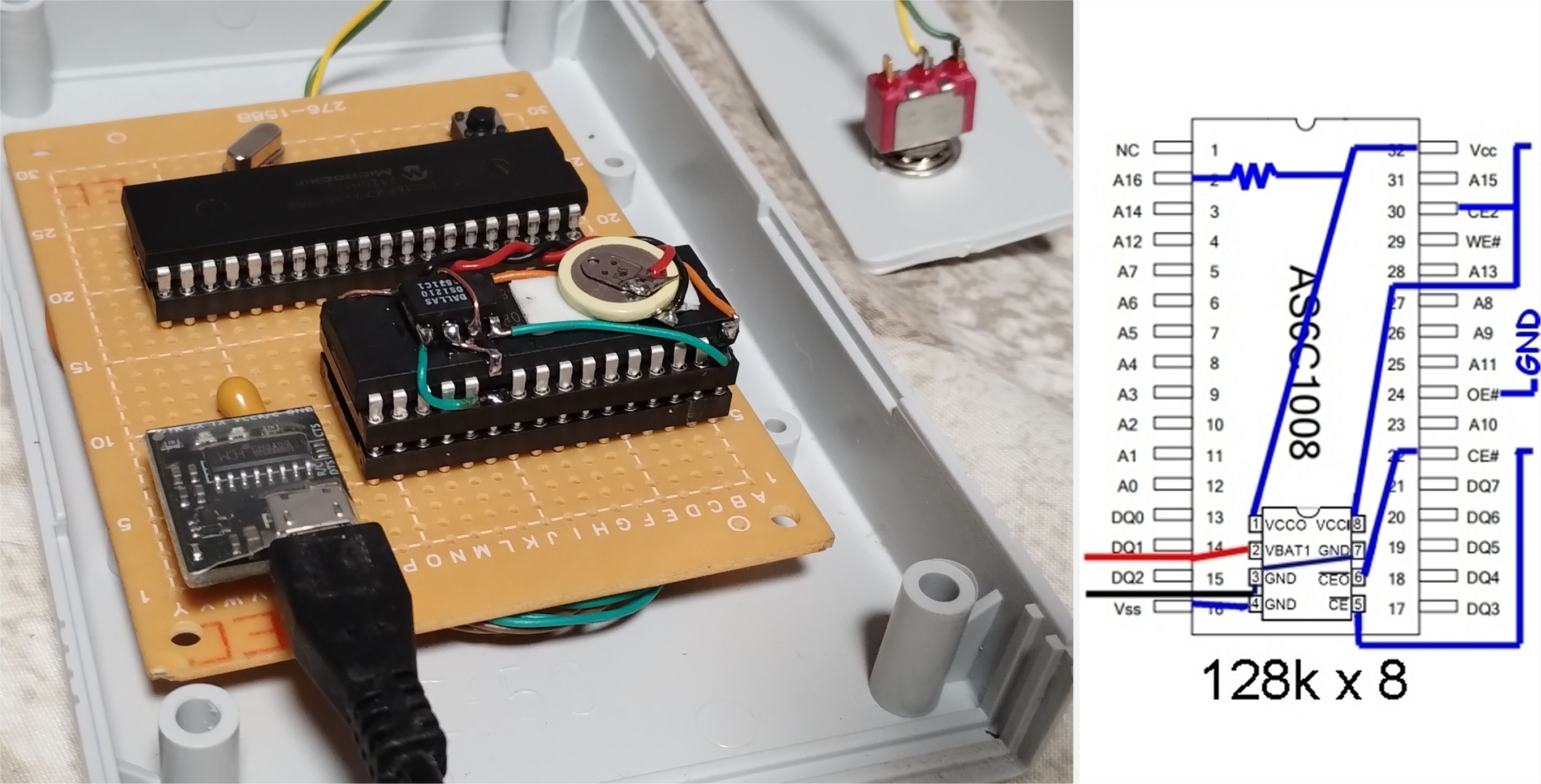
I have the 128k x 8 AS6C1008 in my Grant Searle Z80 with two switched 64k nonvolatile pages, one page to play with and
one dedicated to Star Trek!!! The homebrew NVRAM concept using the DS1210 works great, and its so convenient!
Here's my veroboard KO2019 64k SC/MP box using the same idea: (right-click, open in a new tab for a full-size pic)
|